
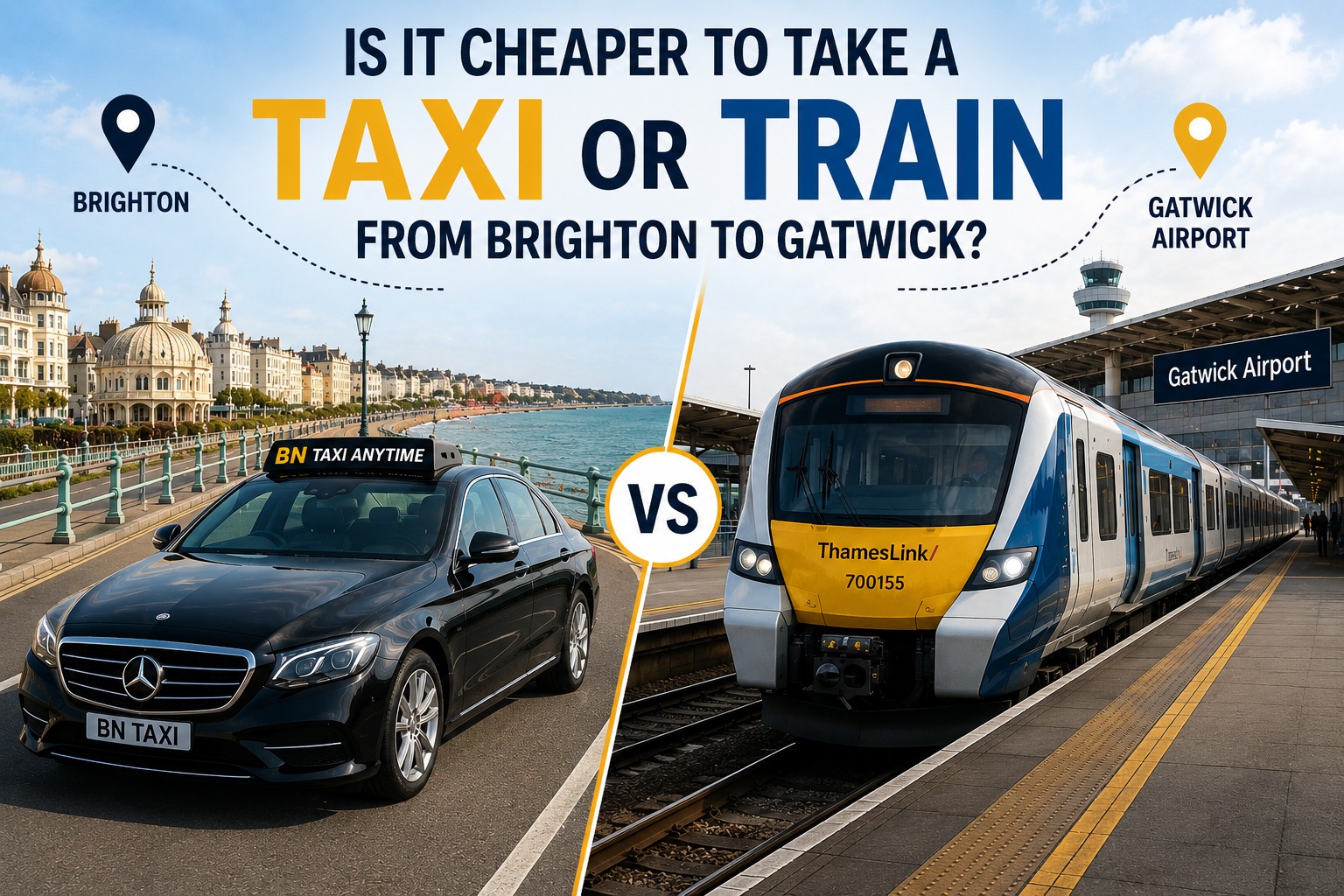
Is It Cheaper to Take a Taxi or Train from Brighton to Gatwick?
Quick answer: For one person travelling alone, the train is usually the cheaper option — a Thameslink ticket typically costs somewhere between £11 and £40 depending on how far in advance you book, against a fixed taxi fare of roughly £45–£60. But once you're travelling as two or more people, or carrying more than a couple of suitcases, a taxi often works out cheaper per person and is almost always faster and less stressful door-to-door. There's no single right answer — it depends entirely on how many of you are travelling and how much you're carrying. Below, we break down the real numbers so you can work out which makes sense for your specific trip.
The Short Version: Taxi vs. Train at a Glance
| Factor | Taxi | Train (Thameslink) |
|---|---|---|
| Typical cost (1 person) | £45–£60 (fixed) | £11–£40 (one-way) |
| Typical cost (2 people) | £45–£60 total | £22–£80 total |
| Typical cost (4 people) | £65–£85 total | £44–£160 total |
| Journey time | 35–45 minutes | 30–40 minutes |
| Frequency | Book any time | Every 15–20 minutes |
| Luggage | No extra charge, door-to-door | Manageable, but you carry it yourself between platforms |
| Best for | Groups, early/late flights, heavy luggage | Solo travellers, light packers, fixed budgets |
As the table shows, the crossover point is almost always about group size. A train ticket is priced per person, so the cost multiplies with every extra passenger. A taxi is priced per journey, so the cost barely changes whether there are one, two, or four of you in the car.
How Much Does the Train Actually Cost?
Thameslink runs a direct service from Brighton station straight into Gatwick's South Terminal, with trains roughly every 15–20 minutes throughout the day. National Rail also lists ticket options and live times for the same route if you want to compare fares directly before booking.
Train pricing varies quite a bit depending on:
- How far in advance you book — advance tickets are usually cheaper than turning up on the day
- Time of travel — peak-time tickets (weekday mornings and early evenings) tend to cost more than off-peak
- Ticket type — a single, an off-peak return, or a flexible anytime ticket all carry different prices
As a rough guide, a one-way ticket typically falls somewhere in the £11–£40 range per person. If you're travelling with a partner or friend, that's £22–£80 for two people — already creeping toward, or past, a fixed taxi fare for the same journey.
How Much Does a Taxi Actually Cost?
Most reputable local operators, including BN Taxi Anytime, offer a fixed price for the Brighton to Gatwick route rather than a metered fare. That means the price you're quoted at booking is the price you pay, regardless of traffic on the A23 or M23 on the day.
| Vehicle Type | Typical Capacity | Indicative Price Range |
|---|---|---|
| Standard Saloon | Up to 3 passengers, 2 large cases | £45–£60 |
| Estate Car | Up to 4 passengers, 3–4 large cases | £55–£70 |
| MPV / 6-Seater | Up to 6 passengers, 5–6 large cases | £65–£85 |
Because this price is fixed per vehicle, not per person, a family of four splitting an £85 MPV fare pays roughly £21 each — often cheaper than four individual train tickets, especially at peak times.
Cost Comparison by Group Size
This is really where the “which is cheaper” question gets answered. Here's how the two options compare as more people join the trip (using the midpoint of each price range above):
| Travelling As | Taxi (Total) | Taxi (Per Person) | Train (Total, ~£25pp avg) | Train (Per Person) |
|---|---|---|---|---|
| Solo traveller | £52 | £52 | £25 | £25 |
| Couple (2 people) | £52 | £26 | £50 | £25 |
| Family of 3 | £52 | £17 | £75 | £25 |
| Family of 4 | £75 | £19 | £100 | £25 |
The pattern is clear: train pricing stays flat per person no matter the group size, while taxi pricing per person drops sharply as more people share the same fixed fare. Somewhere around two to three people, the crossover typically happens — and beyond that, the taxi is very often the cheaper choice overall, before you've even factored in convenience.
It's Not Just About the Ticket Price
The headline fare isn't the whole story. A few extra costs can tip the balance either way:
- Getting to the station. If you don't live within easy walking distance of Brighton station, you'll need to add on a local bus, taxi, or parking cost just to start your train journey — which narrows the price gap with a door-to-door taxi considerably.
- Luggage. The train is free for standard luggage, but you're responsible for carrying and lifting it yourself, including at any platform changes. A taxi handles this for you.
- Parking at Gatwick station or Brighton station, if you're being dropped off by car rather than driving yourself, isn't usually a factor — but if you're driving to Brighton station and leaving your car there, station parking fees should be added to the train's true cost.
- Peak train fares can be significantly higher than off-peak, so a taxi's fixed price can look more competitive if your flight happens to fall in a peak travel window.
Journey Time: Which Is Actually Faster?
Both options are surprisingly close on time. The train takes around 30–40 minutes direct from Brighton to Gatwick, while a taxi typically takes 35–45 minutes depending on traffic on the A23/M23. In practice:
- The train can be faster in isolation, but only if you don't need to travel to the station first, wait for a connection, or manage stairs/platform changes with luggage.
- The taxi picks you up from your exact address and drops you at the terminal door, so while the driving time might be slightly longer, the total door-to-door time — including getting to a station, waiting for a train, and walking from the platform to check-in — is often very similar, or even shorter by taxi.
If you're travelling with an early-morning flight, this matters more than it looks: early trains run less frequently, whereas a taxi can be booked for any pickup time you need, including well before 6am.
When the Train Wins
The train is generally the better choice if:
- You're travelling alone or as a pair
- You're packing light — one bag you can comfortably carry yourself
- Your budget is tight and you can book in advance for a cheaper fare
- You live close to Brighton station, so getting there adds little extra time or cost
When the Taxi Wins
A taxi generally works out better if:
- You're travelling as a group of three or more
- You have multiple suitcases or bulky luggage
- Your flight is very early or late, when trains run less frequently
- You want door-to-door convenience with no walking, waiting, or platform changes
- Your flight could be delayed, and you'd rather have a driver monitoring it than worry about missing a specific train connection
If cost certainty matters to you regardless of delays, a fixed-price taxi also removes one more variable — the price agreed at booking is the price you pay, whereas peak-time train fares can vary depending on exactly when you end up travelling.
An Alternative Worth Knowing: The Coach
If pure budget is the only concern, it's worth mentioning a third option: National Express coaches run between Brighton and Gatwick with one-way fares that can start from under £10, though the journey takes a little longer, typically around 45 minutes. It's rarely faster than the train and won't beat a shared taxi fare for a group, but for a single traveller on a strict budget with time to spare, it's the cheapest of all three options.
Tips for Getting the Best Price, Whichever You Choose
Whether you end up booking a train ticket or a taxi, a few habits make a real difference to what you actually pay:
- Book ahead where you can. Train fares in particular can rise sharply the closer you get to your travel date, and taxi availability at busy times (early mornings, weekends, school holidays) can be tighter without advance notice.
- Check off-peak windows. If your flight timing gives you any flexibility, travelling just outside the weekday morning and evening peaks can noticeably reduce train fares.
- Compare the total group cost, not just the per-ticket price. It's easy to compare a single train fare against a taxi quote and assume the train wins — but always multiply the train fare by the number of people actually travelling before deciding.
- Ask about fixed vs. metered pricing if you're comparing taxi operators. A fixed price protects you from cost increases due to traffic, while a metered fare technically could work out cheaper on a very clear-traffic day — but carries more risk of costing more if the journey is delayed.
- Factor in the return leg too. If you're comparing costs for a round trip, remember that train tickets are priced per journey (so double the one-way fare, or check for a return ticket discount), while some taxi operators offer a modest discount for booking both legs of the journey at once.
None of these tips guarantee the absolute cheapest possible fare every time, but together they typically shift the balance in your favour — regardless of which option you end up choosing.
Frequently Asked Questions
Is the train always cheaper than a taxi from Brighton to Gatwick?
Not always. For a single traveller booking in advance, the train is usually cheaper. But once two or more people are travelling together, a fixed-price taxi often matches or beats the combined cost of individual train tickets.
Does the taxi price change if my flight is delayed?
No — with a fixed-price booking, the fare agreed at the time of booking doesn't change due to traffic or delays. A good operator will also monitor your flight and adjust pickup time automatically at no extra charge.
Is the train direct from Brighton to Gatwick?
Yes, Thameslink runs a direct service from Brighton station to Gatwick's South Terminal, with no changes required, roughly every 15–20 minutes.
What if I'm travelling with a lot of luggage?
This is one of the clearest cases for a taxi. You won't need to carry, lift, or manage suitcases across platforms or station stairs — the driver handles it door-to-door.
Which option is better for an early morning flight?
A taxi, in most cases. Early trains run less frequently, and a taxi can be booked for any pickup time, including well before 6am, without needing to work around a fixed timetable.
Can I get an exact price comparison for my specific trip?
Yes — for the taxi side, get an instant fixed-price quote for your exact date, time and group size. For the train, check live fares directly with Thameslink or National Rail before you travel.
The Bottom Line
If you're travelling solo and packing light, the train is very likely your cheapest option, especially if you book ahead. But the moment you're travelling with someone else, carrying more luggage, or flying at an inconvenient hour, the maths shifts quickly in favour of a taxi — and that's before factoring in the simple convenience of being picked up at your door and dropped directly at the terminal, with no walking, waiting, or timetable to plan around.
For a detailed look at what a taxi from Brighton to Gatwick costs by vehicle type, see our full guide: How Much Does a Taxi from Brighton to Gatwick Airport Cost?
Ready to Compare for Your Own Trip?
Get an instant, fixed-price taxi quote from BN Taxi Anytime and compare it against live train fares before you decide — with a fixed price, free flight monitoring, and door-to-door service, there are no surprises either way.